







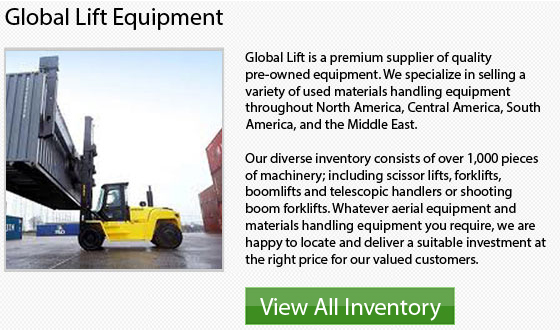
A telehandler or a telescopic handler is a machinery which is well-known within the agriculture and construction businesses. These machines are similar in appearance and function to a lift truck or a forklift but are really more like a crane rather than a forklift. The telehandler provides increased versatility of a single telescopic boom which can extend forwards as well as upwards from the vehicle. The operator can connect many attachments on the end of the boom. Some of the most popular attachments include: a muck grab, a bucket, pallet forks or a lift table.
In order to transport loads through places which are usually not reachable for a conventional forklift. The telehandler utilizes pallet forks as their most common attachment. For example, telehandlers can transport cargo to and from places that are not typically reachable by conventional forklift models. These devices can also remove palletized cargo from within a trailer and position these loads in high areas, like on rooftops for example. Previously, this aforementioned situation will require a crane. Cranes can be really pricey to use and not always a time-efficient or practical option.
Telehandler's are unique in that their advantage is also their biggest drawback: as the boom raises or extends when the machinery is bearing a load, it also acts as a lever and causes the vehicle to become quite unstable, despite the counterweights on the rear. This translates to the lifting capacity decreasing fast as the working radius increases. The working radius is the distance between the center of the load and the front of the wheels.
For example, a vehicle that has a 5000 lb. capacity with the boom retracted may be able to safely raise just as heavy as 400 pounds when it is completely extended with a low boom angle. The same unit with a 5000 pound lift capacity that has the boom retracted may be able to easily support as much as 10,000 pounds with the boom raised up to 70.
England originally pioneered the telehandler in Horley, Surrey. The Matbro Company developed these machinery from their articulated cross country forestry forklifts. Initially, they had a centrally mounted boom design on the front portion. This positioned the cab of the driver on the rear portion of the equipment, like in the Teleram 40 unit. The rigid chassis design with the cab located on the side and a rear mounted boom has ever since become more famous.